
Rashika Jackson, partner for Meta Marketing Research in the Middle East.
The modern digital landscape gives marketers access to a seemingly limitless amount of data. But are you really using this information? In many organizations, this is not the case. Over the past decade, direct responders have used a variety of data sources, such as cookies and mobile device IDs, to measure ad performance. Access to this information is becoming increasingly complex, and with it measurement systems such as channel-level reporting and cross-channel attribution are becoming more effective.
Indigenous brands accustomed to rapid and iterative optimization based on detailed data need to rethink their measurement strategy. This category includes disruptive product marketers: startups that were born on the Internet and are delivering value to customers in new and innovative ways. It's time for marketers, including digital natives, to develop existing marketing analytics. In the year Looking forward to 2023, Marketing Mix Modeling (MMM), a marketing and business statistical analysis, will be a promising measurement solution for brands looking to gain actionable insights into multi-channel marketing results.
As privacy laws change how marketers collect and use data, here's how brands can use marketing mix modeling to gain insights and measure performance.
Marketing mix modeling in the new era
Innovations in machine learning algorithms allow MMM to predict valuable data with the required level of detail and speed. Since it is not based on individual data, it represents a single, comprehensive and sustainable measurement system in the data ecosystem. It's great to see marketers moving towards continuous MMM, building capacity and hiring full-time managers. A good indicator of this change is the growth of the RobinMM open source community on Github and Facebook . Over 1000 marketers, analysts and data enthusiasts are talking, discussing and learning as they travel the MMM path.
In a recent study by Accenture, they conducted several experiments using custom MMM to test its suitability for disruptive marketers who need a reliable and affordable system to inform detailed media optimization.
Their results show that MMM provides the following advantages when used with advanced machine learning techniques and innovations.
1) Reliable MMM is applicable to traders of all sizes and categories: The success of MMM is largely measured by the model's ability to predict outcomes. Accenture's test of 1,200 data attributes collected from 5 different sources by traditional brand marketers and innovators showed high predictive accuracy, with an R of 90% between 5% and 90% of industry benchmarks. or less in mean percent absolute error (MAPE).
2) MMM can provide accurate and practical results. With advances in machine learning, MMM can now use techniques like gradient descent to process data and derive valuable insights based on these variables. In the Accenture study, the model breaks down two years of data every week, which is an important measure for marketers when setting a daily budget (as shown in Figure 1). This is an example of how MMM can provide detailed and useful information that can be used to optimize marketing effectiveness.
3) MMM shows integration between channels without user supervision. Specialty brands seek to understand customer conversion paths to optimize their omnichannel marketing efforts. Marketing mix models combined with advanced machine learning techniques can provide similar insight into integration across channels. Accenture's experiment provided clear data on cross-channel influence. The results are summarized below in the “network” of contributing factors in Figure 2.
A method that consistently meets your basic measurement needs
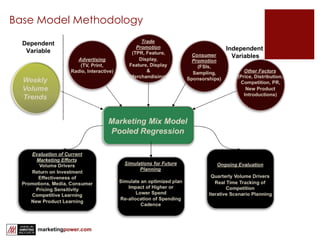
MMM integrates and evaluates all online and offline marketing activities, builds a picture of their relationships and expands the ability to monitor factors such as promotions, seasonality or competition. Today, MMM requires minimal resources and budget to implement and uses regularly collected data to deliver information quickly and accurately across multiple channels, making it ideal for marketers of all sizes, including those focused on direct response advertising. Breakthrough brand marketers, who often deal with business transformations and use a variety of unpaid marketing strategies, also benefit from the holistic approach offered by MMM.
Here are four best practices for getting actionable, real, and sustainable results.
1) Align key targets before building models. Given the wide range of questions MMM can answer, it is important to develop an MMM training program and focus on one question at a time. Agreeing on key goals is an important first step in the MMM process. All subsequent steps in the process of building an MMM are guided by a clear understanding of the key functions of the MMM.
2) Make sure the data is up-to-date and complete : Create unique variables for each strategy marketers want to measure ROI. In addition to developing media-related variables, it is important to include a comprehensive list of non-media variables that may affect a brand's business results. These variables vary from brand to brand, but common ones include economic factors, seasonality, competition, etc.
3) Choose an MMM option that answers your questions - The most common questions are usually answered by the various MMM options on the market, such as open source solutions like Robin, a partner solution, or self-service MMM. SaaS solution. When evaluating MMM options, make sure their capabilities effectively answer the questions asked in Step 1 so brands can benefit from MMM.
4) Regularly update and adapt the MMM to reflect business changes: Investing in an information infrastructure that automatically incorporates new data into the MMM model will help marketers and modelers achieve the long-term effectiveness of updating MMM models. It is important to create a basis for choosing the most reliable size of MMM model. Incremental studies are the gold standard in the industry for measuring baseline accuracy. To improve model accuracy and build confidence in MMM implementation, marketers should conduct additional research on their marketing channels with MMM management.
Reliable measurement solutions require a solid foundation
MMM and its evolutions are here to stay. It's time for disruptive brands to stop waiting and start their MMM journey. The best way for marketers to understand the effectiveness of advertising is to use rapid modeling with cause and effect testing. Setting up marketing mix modeling now, before closing doors to individual data, can help brands prepare for changes in online privacy. Invest time and resources to build now; It gives value to those who work.
