
Like it or not, apps have become an everyday standard for businesses and consumers alike. Shopping, banking, traveling and gaming, there's an app for everything. In fact, a recent study found that 88% of mobile time is spent on apps.
According to Statista for the second quarter of 2022, there are more than six million apps in the Google Play, Apple and Amazon stores.
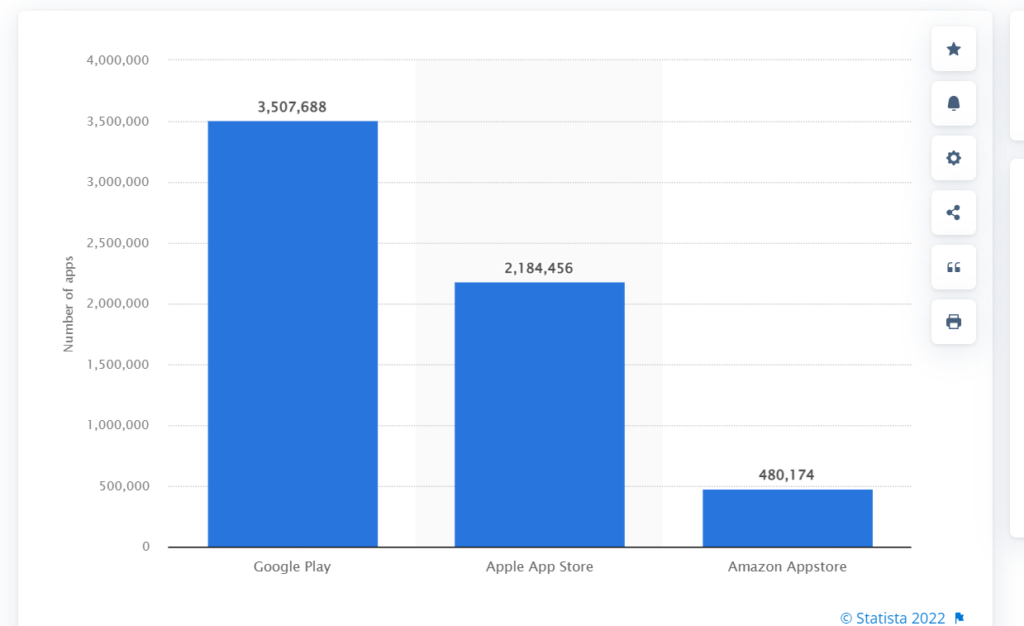
Source: Statistics
This is why marketing your app correctly is more important than ever and has become an important part of any business marketing strategy. But to be effective, programmatic marketing must consider the entire ecosystem that affects your program's marketing effectiveness. Whether it's App Store Optimization (ASO) or a combination of organic and paid user acquisition (such as through Google App campaigns and Apple search ads), marketers need to look at data holistically and ask the right questions when analyzing app performance.
Here I will share my knowledge and trading strategies that I have acquired over the past 10 years in the field of marketing.
Organic growth alone won't get you far
While ASO may have been the most important part of your app marketing strategy a few years ago, you need to strengthen your user acquisition (UA) strategy to stay competitive in the app marketing environment. That's not to say that ASO doesn't matter anymore - it certainly does, but it needs to be combined with a paid user acquisition strategy for sustainable app growth. The primary goal of organic and paid OS is to improve conversion quality while keeping the cost per conversion low.
For starters, you need a solid ASO foundation to keep quality users flowing through your channels. This is important because the user will be featured in your app store. If you're not investing time in ASO and optimizing your store listings, you're wasting money.
Attracting paid users can lead to more natural app installs. Ads will draw attention to your app listing in the store. The more installs your app gets, the higher its app rank in the App Store. As a result, this increases the visibility of search results and browsing categories. With increased visibility, more users will visit your organic store listings and download your app. This is why the cycle of growth continues!
A successful strategy lies in understanding the relationship between ASO and paid user acquisition efforts. You need to understand how your paid funnel affects organic growth and vice versa. At GAME, we used a comprehensive App Radar platform that helped our team work on a single system to understand and maximize the impact of organic and paid user acquisition for Google and the Apple App Store.
Analysis of application performance
After putting a lot of effort into UA optimization, don't sit back and expect great results. During the campaign, you need to analyze the effectiveness of your program and ask the right questions. You probably want to know how your ASO efforts are growing. Or is your paid UA traffic increasing or decreasing? All of these questions can be difficult to answer, especially given the many factors that can play a role. Let's take a few scenarios as examples.
Scenario 1: The number of app installs decreases.
Are you seeing a drop in installs? At first glance, this may cause concern. However, the good news is that there will be an explanation for every drop in aid. And every problem has a solution.
One of the most important influencing factors to consider is your efforts to attract paying users If you notice a drop in downloads, the first thing you should do is check if your ads are showing at that particular time. Ads can drive a lot of traffic to your program, and turning them off or reducing them can have a big impact on your results. Explore the relationship between organic and paid conversions, then analyze how your paid conversions are contributing to your overall growth and understand if an increase in installs could be due to a decrease paid channel activity.
So what is it now?
First, try to get a better picture of the situation by looking at the last 30 or 90 days and see how it has affected you. For example, if pausing your Google programmatic campaigns significantly reduces your installs, you should consider reactivating your ads.
Second scenario: App installs are growing
This is the result we all strive for. Ideally, you want this to continue throughout the marketing campaign and beyond, but you need to know what caused the spike. It can be hard to transfer one success to another if you don't know where that success came from.
It's best to look at conversion analysis to find the answer. Is it Google Ads, Apple Search Ads, another paid channel or ASO? If you launch a campaign through a specific channel at the same time as your installs are growing, it's likely to drive overall growth for your app. It is also worth evaluating which advertising platform is most effective. Are you getting better CPA through paid channels? To find out if your program is good or bad, you can compare the numbers with previous campaigns. How have your impressions, conversions and spend changed since the last time? Taking all of this into consideration will help you decide if you need to change your approach or adjust your campaign.
Three ways to experience GAMEE
At GAMEE, we've learned that there are three elements that every marketer must constantly work on:
ASO
This is the end of all actions in the application. Every dollar and hour invested elsewhere can be multiplied with a good ASO strategy and approach. Using the App Radar platform is invaluable to improving the effectiveness of our campaigns.
Tests
For best results, use custom app store listings (when possible), multiple combinations of paid ad networks, and app store A/B testing.
Prioritize
Select audiences, markets, regions and/or demographics and target your ASO and paid channels to win and target them.
While analyzing the impact of organic and paid user acquisition is a daunting task, one thing you don't want to do is put all your eggs in one basket. You can't rely on organic UA alone or paid UA alone. For a successful app marketing strategy, both areas must work together. Your company should have a place for testing. This allows you to adjust and change your strategy according to your target audience. Trust me, if managed properly, your application will reap the rewards of your strategy in no time.
Jan Gemrich is the Chief Marketing Officer of GAMEE, an active gaming platform with over 30 million users. GAMEE is part of the Animoca brand, a leading blockchain gaming company. Jane previously worked for over 9 years at Google in Prague, London and Toronto, where she was responsible for user growth (Google Pay, Android, Search) and new product launches (Pixel, Stadia, etc.).
Subscribe to the Search Engine Watch newsletter to learn about SEO, the search environment, search engine marketing, digital marketing, leadership, podcasts and more.
Join us on LinkedIn and Twitter.
